
The Building Blocks of the Universe – New Book by Professor Thomas Just Sørensen
We lack a truly fundamental understanding of the world we live in, says Thomas Just Sørensen, author of The Building Blocks of the Universe. But now you can gain that understanding, even if you are not a chemist or physicist, by reading his book. The conversation about scientific literacy in our society starts here.
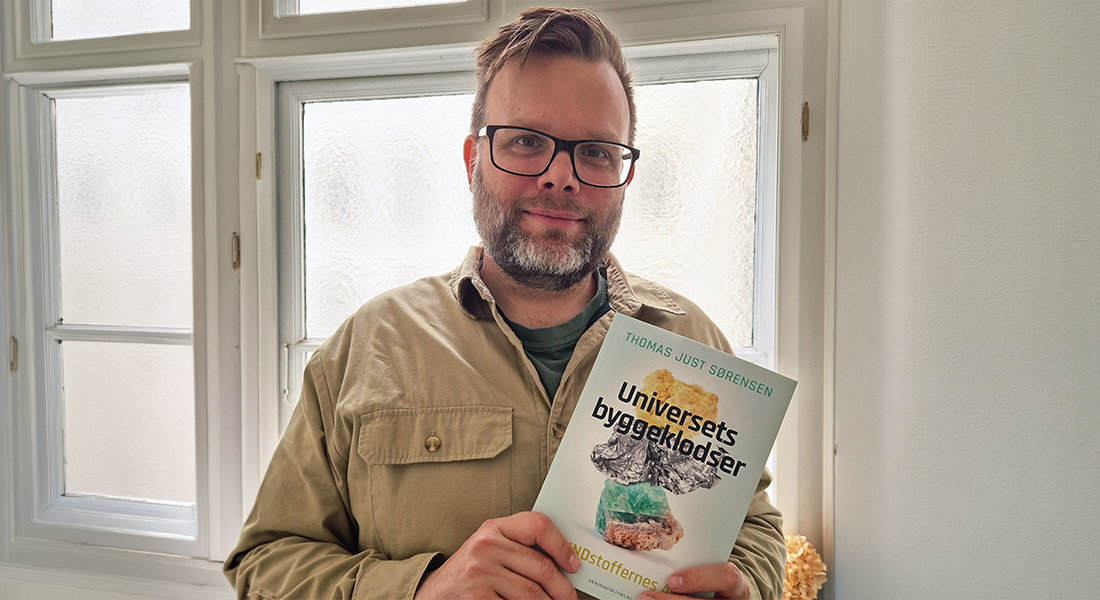
Where does everything come from? And what is everything actually made of?
If you have ever asked yourself that question while running your fingers along a tree trunk, holding a heavy iron dumbbell in your hand, or hearing the cacophonous sound of shattering glass, then you are certainly not alone.
According to the author, Professor Thomas Just Sørensen of the Department of Chemistry, the real answer to that question is not easy to grasp. We lack a basic understanding of what the chemical elements of the universe actually are, why they differ so dramatically from one another, and how they interact in the world we both live in and help create every day.
Conveniently, the elements are organized in the Periodic Table, and in The Building Blocks of the Universe, Thomas walks readers through all of them, with excursions into their history and explanations of the concepts needed to understand them.
The book answers questions such as: What is an atom? How many elements are there? Where do they come from? Which elements are man-made? How remarkable is it that Earth is solid and coherent? And, of course, how does the Periodic Table itself work?
The material is richly illustrated with striking figures, numerous photographs, and examples of how the elements are commonly used in the world around us.
Science communication is a societal responsibility—at every level
Thomas explains that his own journey in communicating his scientific field, chemistry, has been a long one. This book emerged from a science communication collaboration with Videnskabsklubben (“The Science Club”).
The founders of Videnskabsklubben were disappointed that their children could not “go to science” in the same way they could go to football or table tennis practice. So they created exactly that opportunity—and asked Thomas to help with the chemistry component.
Thomas developed a game based on the Periodic Table aimed at older primary school students, high school students, and, in fact, all curious adults. At some point, he was encouraged to create a book containing the knowledge presented through the game.
At the Department of Chemistry, he teaches first-year students and uses resources such as this book to help (re)build the conceptual framework necessary for reading and understanding science. To support that effort, he even draws on a Russian correspondence course from the 1940s. In a correspondence course, a chapter is sent to you by mail; there is no teacher present, and you must solve the assigned problems based on just two to five pages of text. It is a fundamental exercise in literacy through reading comprehension and problem-solving.
Let’s start an informed conversation about scientific literacy
Thomas hopes to inspire a grassroots movement demanding that, for example, primary school teachers be given the opportunity to receive a much deeper introduction to and understanding of the educational value embedded in science.
We start learning English in the second grade—that is linguistic and cultural literacy. Why, then, is scientific literacy given such low priority?
You do not need to know Russian, unlike Dmitri Mendeleev, the creator of the Periodic Table. You can browse the book however you like, dip into chapters at random, or read it from cover to cover—the only requirement is that you let your curiosity guide you.
PS: The game is sold out presently – but it will be back on the shelves at the end of August